

Neurofeedback for ADHD
in Meridian, Boise, and the Treasure Valley

Supporting ADHD Starts with the Nervous System
If ADHD feels like a constant battle, it may not be a lack of effort—it may be a brain that’s stuck in the wrong state.
ADHD doesn’t just affect focus.
It can impact behavior, emotions, sleep, and the ability to follow through day to day.
At Clear Mind Idaho, we take a different approach.
Using gentle, non-invasive microcurrent neurofeedback, we support the brain’s natural ability to regulate—so focus, behavior, and emotional responses can begin to improve.
It’s not just about focus.
For many people with ADHD, it looks more like:
Starting tasks… but not finishing them
Feeling constantly distracted or mentally scattered
Big emotions that feel hard to control
Struggling to slow down—mentally or physically
Getting overwhelmed by simple, everyday things
Knowing what to do… but not being able to follow through
Over time, this can start to feel frustrating, exhausting, and defeating.
Especially when it feels like no matter how hard you try…
it’s just not clicking.


It’s not a lack of effort.
It’s a regulation issue.
When the brain and nervous system aren’t regulating efficiently, everything takes more effort:
Focus
Behavior
Emotions
Follow-through
This is why “trying harder” often doesn’t solve the problem.


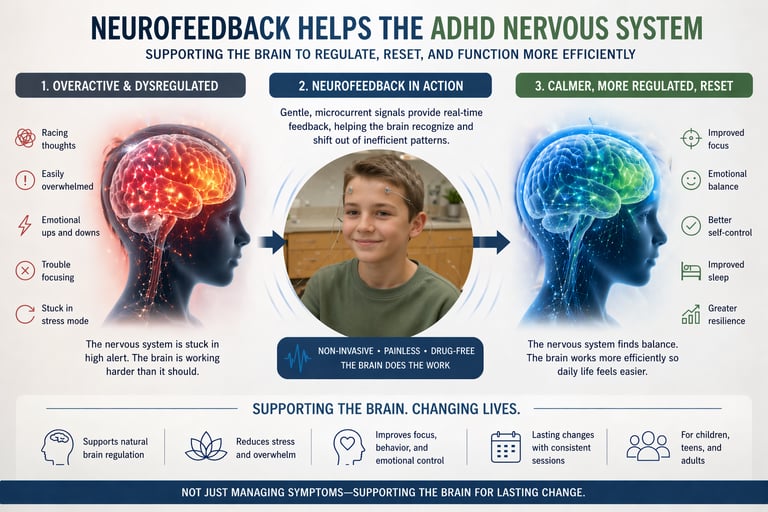
Helping the brain work more efficiently
Microcurrent neurofeedback is designed to support the brain’s natural ability to regulate itself.
Instead of asking the brain to try harder, it gives the brain gentle feedback—helping it recognize and shift out of inefficient patterns.
Over time, this can support smoother, more consistent brain function.
What this can look like
As the brain begins to regulate more effectively, many individuals notice improvements in:
Focus and attention
Emotional regulation
Mental clarity
Ability to follow through
Sleep
Overall sense of calm
This doesn’t come from forcing change.
It comes from the brain functioning more efficiently.


What sessions are like
Sessions are simple and low effort.
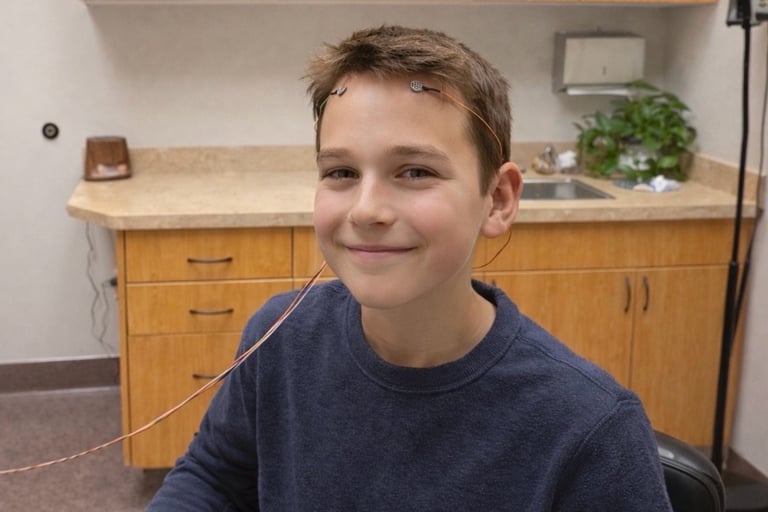
Small sensors are placed on the scalp
The system reads brain activity and delivers extremely low-level signals
The brain responds naturally—no effort required
Sessions are:
Gentle
Non-invasive
Passive (you don’t have to “do” anything)
A Different Kind of Support
This approach is not about managing symptoms in the moment.
It’s about supporting the brain so those symptoms don’t feel as intense or constant over time.
Why some people look for more
There are different ways people choose to support ADHD—and medication is one of the most common.
For many individuals, medication can help improve focus, attention, and impulse control, especially in the short term. For some, it makes a meaningful difference in day-to-day functioning. At the same time, many individuals and families begin to notice:
The effects may wear off throughout the day
Adjustments or changes are sometimes needed over time
Side effects can be a consideration for some
It may feel like it’s managing symptoms, but not changing the underlying pattern
Because of this, many people start looking for additional ways to support how the brain functions—not just how symptoms show up.

Where Neurofeedback can help
This is where neurofeedback fits in.
Rather than working through brain chemistry, it focuses on helping the brain regulate more efficiently over time.
It can be used:
On its own
Alongside medication
As part of a broader support plan
Our role is to support the brain and nervous system in a different way—so individuals have more options when it comes to improving focus, behavior, and emotional regulation.

Why families choose Clear Mind Idaho
When it comes to ADHD support, many people aren’t just looking for information—they’re looking for something that actually feels different.
At Clear Mind Idaho, our focus is simple:
support the brain and nervous system so real change can happen.
We focus on regulation—not just symptoms
Instead of trying to manage behaviors on the surface, we focus on what’s happening underneath.
When the brain regulates more efficiently, things like focus, emotional control, and follow-through often begin to improve naturally.
A calm, low-pressure approach
We know many individuals with ADHD already feel overwhelmed or frustrated.
That’s why our approach is designed to feel:
Calm
Simple
Low effort
Supportive
There’s nothing to “perform” during a session.
No pressure to get it right.
Designed for real people and real life
This isn’t something that adds more stress to your schedule.
Sessions are:
Short
Passive
Easy to fit into your routine
We work with:
Children
Teens
Adults
A place where you feel understood
We’ve worked with many individuals and families navigating ADHD.
We understand that it’s not just about focus—it’s about how it affects everyday life, relationships, confidence, and overall wellbeing.
You’re not just another appointment here.
Our goal
Not to “fix” you.
Not to push you into something that doesn’t fit.
Our goal is to help the brain get out of stuck patterns—so things can feel easier, calmer, and more manageable.

You don’t have to keep pushing through.
Start with a Free Consultation
If ADHD has been feeling frustrating, exhausting, or overwhelming—there may be a different way to support your brain.
Frequently Asked Questions
What is microcurrent neurofeedback?
Microcurrent neurofeedback is a non-invasive approach designed to support the brain’s natural ability to regulate itself. It uses extremely small electrical signals—similar to the brain’s own activity—to help the brain shift out of inefficient patterns and function more smoothly.
Does neurofeedback help with ADHD?
Many individuals seek neurofeedback to support challenges commonly associated with ADHD, such as focus, emotional regulation, sleep, and follow-through. By supporting how the brain regulates, these areas often begin to feel more manageable over time.
Do I need to stop ADHD medication?
No. Neurofeedback can be used alongside medication or on its own. We do not prescribe or manage medications, but many individuals choose to explore neurofeedback as an additional way to support their brain and nervous system.
What does a session feel like?
Sessions are gentle and passive. Small sensors are placed on the scalp, and the system delivers very low-level signals. Most people simply relax during the session—there is nothing you need to do.
How many sessions are needed?
Every brain is different. Some individuals notice changes within a few sessions, while others benefit from a series of sessions over time. We typically recommend starting with a plan and adjusting based on how your brain responds.
Phone
clearmindstaff@gmail.com
208-999-0541
© 2025. All rights reserved.
2971 E Copper Point Dr. Ste. 125
Meridian, ID 83642
Our Office
This site is for informational and educational purposes only. The information contained on this site does not constitute the rendering of healthcare advice or treatment recommendations. Browsing this site does not establish a professional relationship with our clinic. The information contained on this website has not been evaluated by the F.D.A. and is not intended to treat, diagnose or cure any disease.